
I was about six years old when I remember visiting a nursing home. That’s what my parents called Long Term Care in the 70s. Our family drove on Christmas day to visit with our elderly neighbours, the Coppers, who had move into a nursing home in North Toronto the year before. I remember consciously trying not to scrunch my nose as the pungent odours reached my nostrils. I felt complete terror as residents lurched out to touch me or grab my hand. I was shocked at the number of residents I saw bound to their wheelchairs, some drooling from their mouths. I felt uncertain and unprepared as we entered the Copper’s room, where Mrs. Copper sat in her wheelchair and Mr. Copper lay in his bed, affected by a stroke.
Gingerly, I approached the bed to see Mr. Copper and immediately felt relief and happiness when he smiled at me lopsidedly but with the same twinkle in his eye I came to expect . When I heard the familiarity of Mrs. Copper’s voice and the warmth of her hands, it made my heart leap for joy. I forgot about their diseases, his stroke and her inability to walk due to Parkinson’s Disease. The strangeness of being in a nursing home evaporated. They were the same people who lived across the street from me on Waverley Road. They were the Coppers!
I learned how easy it was for me, an overly exuberant six year old to bring unmitigated joy and happiness to her grandfriends. I brought school art to brag about and hang up on the walls, pictures to flip through, and easy memory games to play and card games like Fish. I took liberties in showing new found skills like dance routines, singing Christmas Carols and colouring pictures with fancy markers. Our family brought special treats like expensive chocolates, hand lotion, home-made Christmas ornaments and gingerbread folk and a pair of new warm wool slippers.
Before I knew it, it was time to go and I felt a little tug at my heart as I waved good-bye, skipping down the hallway. I remember asking my Mom when we could come back to the “Copper’s New and Neat Home”.
The joy that accompanies having family and friends visit can often feel absent from the halls of a residential care facility or in a widowed grandparent’s home.
Our elderly parents, grandparents or aging neighbours can often feel more lonely or isolated as a result of changes in their senses, memory loss, illness or a loss of mobility.
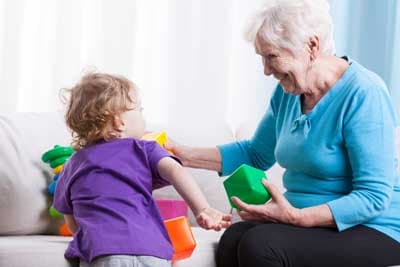
Bringing children and teens to visit with the people we are caring for, regardless of where, is a guaranteed way to lift spirits any time during the year.
It can also be stressful. You might be wondering how to visit with someone with some form of dementia, or who had a stroke, who is frail or who has mobility challenges?
Communication with an individual faced with an impairment or challenge (visual, speech , hearing, cognitive) requires us to :
- BELIEVE that every person, regardless of age and disability, can still be reached at their very core
- BE CREATIVE in how we express our feelings and message
- UNDERSTAND the effects of a disease on communication and behaviour
- BE PATIENT by slowing down, listening, watching, waiting for responses and repeating a phrase using similar or slightly different words
- KEEP LEARNING AND TRYING in how we get our messages and feelings across
Giving the gift of time and sharing the joy we bring as humans matters more than what is said or understood.
Do Your Homework
The more you know about the physical and mental condition of the person you are visiting, the more comfortable you’ll feel. The more you can prepare your young children for a visit, the better. The first couple of times I took my daughter (who was about 4 years old at the time) in for a visit to our local residential care facility, she would often ask why someone doesn’t walk. I did my best to keep it simple and said something along the lines of, “Mrs. Smith has a disease called Alzheimer’s Disease. It affects her brain. Her brain can no longer tell her legs to walk, so she needs to use a wheelchair. You won’t catch Alzheimer’s Disease during our visit.”
We also talked about the smells, sights and sounds that we might encounter. For example, “You may smell the chemicals used for cleaning”, “You may see someone wearing a seatbelt in the wheelchair to keep them safe, just like buckling up in a car”, or “Try not to be frightened or laugh when you hear someone shout or scream. Some older people can’t help yelling, just like you can’t help sneezing. “
Some other helpful hints include:
- Always speak face to face, not from behind
- Get the person’s attention first by a gentle touch, wave, or calling their name
- Remember that you are taller than a person in a wheelchair. Bend down to their eye level before talking.
- Ask the person you are visiting if they need assistance before doing something for them. Don’t be offended if they don’t take you up on your offer to help.
- Ask HOW you can help and LISTEN for instructions
- Before any conversation, find a place or way to minimize or eliminate background noise, such as radio, television, other people, etc and bright lights and other distractions
- If it’s difficult for the person to communication, try different ways of communication – writing, drawing, yes/no, eye contact, facial expressions, etc
- Don’t hide your mouth and avoid shouting
- If you are communicating with someone with cognitive impairment, keep your message simple and only give one message at a time.
Creating Memorable Visits
The most positive visits between an older generation and younger generation are those that create interaction and shared experiences that both the older person and child can enjoy.
- Emphasize one-to-one or small group interaction
- Provide a shared experience such as petting a dog, looking at photos, making a scrapbook, baking cookies, playing a game, playing with puppets, enjoying music, going for a walk, telling stories about the past, bringing in your laptop and playing slideshows or watching home-made videos
- Recognize the frail elders’ limitations (if any) short, frequent visits are often better than longer, but infrequent visits
- Allow the person you are visiting to say when he or she prefers to visit or to decline visits
- Remember the importance of the five senses, especially taste, touch and music. It can be wonderful for a frail elder and a child to share a homemade snack such as a smoothie, hot chocolate, a cookie. A gentle hug, a handshake, or an arm around the shoulder brings human touch to the surface. A singing voice or sharing a familiar song can also bring pleasant memories.